
business can know how many people visited its website, clicked an ad, or filled out a form and still have no real sense of which leads were actually worth acquiring.
That’s starting to change the way digital marketing Calgary businesses rely on gets measured.
The useful data isn’t just sitting in Google Analytics or an ad account. Some of the most revealing information is already tucked away in your CRM, email platform, booking system, sales pipeline, and customer database. Bring those pieces together, and you start seeing what a good lead looks like beyond a form submission.
That can change how you approach SEO, Google Ads, and even the content you decide to publish.
Your Best Marketing Data May Already Be Sitting in Your CRM
Consider two leads.
Both came through Google. Both filled out the same form. Both cost roughly the same to acquire.
One became a $4,000 customer. The other never responded.
If your reporting stops at “two leads generated,” there’s no difference between them.
Your CRM tells a different story.
It can show which lead booked a consultation, which one actually purchased, where they came from, how long it took to close the sale, and whether they came back again.
That’s first-party data. It comes straight from the interactions your business has with its customers and prospects. And suddenly, the question changes.
Instead of asking:
“Which channel generated the most leads?”
You can ask:
“Which channel is generating the leads we actually want?”
That’s the kind of information that can change where you put your marketing budget.
SEO Can Bring Traffic. CRM Data Can Tell You What That Traffic Was Worth.
SEO reporting often stops at rankings, clicks and conversions. Those numbers matter, however, they don’t always tell the whole story.
Imagine a Calgary company ranking for two groups of searches:
| Search behaviour | Leads | Closed customers |
| Informational searches | 82 | 4 |
| High-intent service searches | 31 | 12 |
✅ If you’re judging SEO purely on lead volume, the first group looks impressive.
✅ If you’re judging it on business outcomes, the second group is far more interesting.
That is why SEO agency Calgary businesses should be thinking beyond keyword rankings and form submissions. Search data can tell you what people are looking for. CRM data can tell you what happened after they found you.
Together, they can reveal which topics, landing pages and search terms are attracting commercially valuable prospects.
That can influence the next content brief, the next service page and even which keywords deserve more investment.
The SEO report tells you who arrived. The CRM can tell you who mattered.
Google Ads Calgary Gets Smarter When It Knows What a Good Customer Looks Like
There’s a similar opportunity in paid search.
A campaign can bring in 100 leads and still fall flat if most of them never turn into customers.
The ads may not be the problem. The signal you’re giving Google might be.
If every form submission counts as a success, Google has no real reason to tell the difference between someone who becomes a customer and someone who fills out a form, disappears, and never answers another email.
This is where first-party data can help.
Google Ads supports Customer Match, which lets businesses use customer information they’ve collected directly to reconnect with existing customers and prospects across Google’s platforms. Google also recommends combining first-party customer lists with website or app audiences to cover more of the customer journey.
That gives you a better way to look at conversions. Not every lead carries the same value.
Lead → qualified lead → opportunity → customer
Now compare that with:
Click → form → conversion
The second tells you what happened. The first tells you whether the marketing actually worked.
The Real Advantage Is Connecting the Three
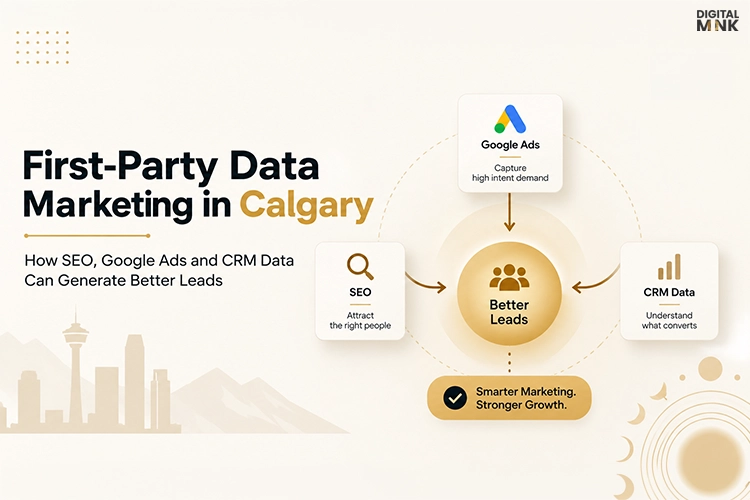
SEO, Google Ads, and your CRM each tell you something different. The useful part starts when you stop looking at them separately.
SEO can tell you what people are searching for and which questions bring them to your website.
Google Ads shows you which high-intent searches you can capture quickly and which messages get people to act.
Then your CRM adds the piece that Google Analytics can’t always give you: what happened after the enquiry came in.
Did they become a qualified lead? Did they buy? How long did it take? Did they come back?
Say your CRM shows that people searching for a specific service become customers far more often than people arriving through broader informational searches. That’s useful information far beyond the sales team.
You might decide to:
✅ Put more SEO effort into that service page
✅ Give related Google Ads keywords more budget
✅ Rework landing pages around what those customers actually care about
✅ Exclude audiences that rarely turn into customers
✅ Create content around the questions those high-value customers ask
The point isn’t to collect more reports. It’s to let what happens after the click influence what you do before the next one.
| INDUSTRY HIGHLIGHT“ If you don’t [capture and activate customer and business data], every new customer will look the same, leading you to over-invest in some, and under-invest in others.” Source: Google, Maximise Growth with Data, 2025 |
Want to know what your own data is telling you?
Talk to Digital Monk Marketing
First-Party Data Doesn’t Mean Collecting Everything
There’s an important distinction here.
Better data does not mean building the biggest possible database.
In Alberta, private-sector organizations are generally governed by the Personal Information Protection Act (PIPA), which sets rules around the collection, use and disclosure of personal information. Organizations generally need consent and must have a reasonable purpose for collecting that information.
So the goal isn’t:
“Let’s collect everything we can.”
It’s:
“What information do we genuinely need to understand and serve our customers better?”
That might be relatively simple:
Lead source + service interest + lead status + customer value + outcome
You don’t need a mountain of fields to make better decisions. You need the right ones.
What This Looks Like for a Calgary Business
Picture a Calgary home services company spending $8,000 a month across SEO and Google Ads. Traffic is up, leads are up, and the cost per lead looks fine. But the owner still isn’t convinced the leads are getting better.
So the company connects its CRM data with its marketing reporting.
Three months later, a pattern shows up. Paid Search brings in more leads, but organic search produces more qualified opportunities. One service page gets relatively little traffic, yet the customers it brings in have a much higher average value.
Now the strategy has something real to work with. SEO gets more attention around that service, Google Ads messaging shifts toward higher-intent searches, and the landing page gets reworked.
The budget isn’t simply following the biggest lead number anymore. It’s following channel, intent, and customer value.
This Is Where a Calgary Marketing Agency Should Add Value
A Calgary marketing agency shouldn’t just hand you three separate reports every month and call it a strategy.
SEO tells you where you’re ranking. Google Ads tells you what people clicked. Your CRM tells you what happened after the enquiry came in.
The useful questions sit somewhere between those numbers.
Which searches are actually producing customers? Which campaigns are bringing in qualified opportunities? Which pages keep showing up in high-value enquiries? Where are good leads dropping off? Which audiences are worth reaching again?
And perhaps the question that matters most:
What did we learn this month that should change what we do next month?
That’s where reporting starts turning into marketing intelligence.
If you’re comparing lead generation companies Canada has to offer, it’s worth asking how they connect marketing activity to actual customer outcomes, not just how good their dashboards look.
| Bring your SEO, Google Ads, and customer data together to see what’s actually driving growth. Explore Digital Marketing Services |
The First-Party Data Flywheel
The real value isn’t one better campaign. It’s what your business learns from each customer and feeds back into the next campaign.
Someone searches, visits your site, becomes a lead, and eventually becomes a customer. Your CRM captures what happened along the way. That information can then shape your SEO, Google Ads, targeting, and content.
Search → visitor → lead → customer → insight → better marketing
The cycle keeps going.
And with people discovering businesses through Google, AI search, Maps, social media, and referrals, understanding your own customers matters more than ever.
Your competitors can see your keywords. They can’t see what your customers taught you.
| Before You Spend More on Lead Generation Before increasing the budget, ask: ✅ Which channels bring our highest-value customers? ✅ Which keywords bring qualified opportunities? ✅ Are our Google Ads conversions tied to actual customers? ✅ Does CRM data influence our SEO and paid search? ✅ What do we know about our customers that competitors don’t? If you’re unsure about most of these, more spending may not be the answer. You may not need more leads. You may need better information about the ones you already have. Speak with our lead generation expert |
The Better Digital Marketing Calgary Businesses Should Be Building
First-party data isn’t another dashboard to add to the marketing stack. It is a way of making the existing stack more intelligent.
SEO can uncover demand. Google Ads can capture it. Your website can convert it. Your CRM can tell you what happened next.
When those systems remain disconnected, marketing tends to optimize for activity: more traffic, more clicks, more leads.
When they work together, the conversation changes to quality, value and outcomes.
That’s the direction any digital marketing company in Calgary should be pushing toward.
Not simply generating more names in a spreadsheet.
Generating better leads, learning which ones matter, and using that knowledge to make the next marketing decision smarter than the last.