
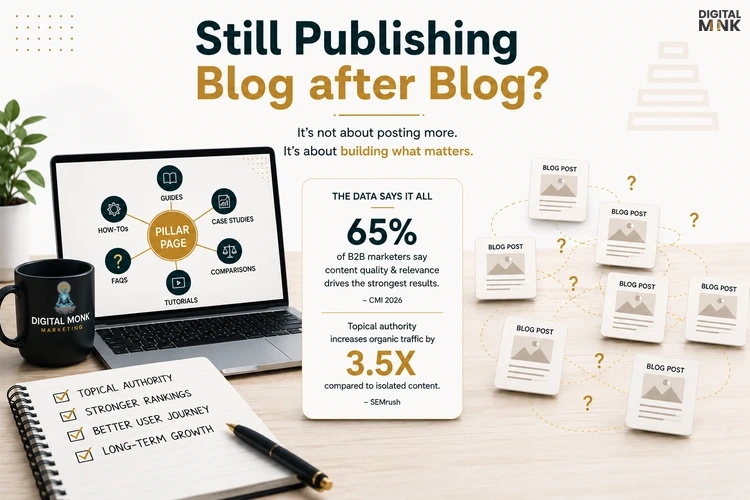
Your 80th Blog Post Might Be Doing Less Than Your 20th
A Calgary business has been publishing twice a month for years. There are articles on customer questions, buying advice, seasonal topics and industry trends. Eighty posts later, the blog looks healthy.
Then someone clicks through it.
The articles barely connect. Older pieces are buried. Several cover almost the same ground. A useful guide sits three clicks away from the service it should support.
Nothing is technically wrong. The problem is that the content isn’t working as a system.
That is where content marketing strategy becomes more than a publishing calendar. Search has changed, too. People now move between traditional results, AI-generated answers, videos, reviews and websites before making a decision.
So the question for 2026 isn’t simply, “How often should we blog?”
Should you keep adding individual articles, or start making the content you already have work together?
The Publishing Calendar Isn’t a Content Strategy
Tuesday arrives.
Another blog goes live.
Everyone feels productive.
Then next Tuesday comes around.
Publishing twice a month isn’t a bad habit. It becomes a problem when the calendar starts making strategic decisions for the business.
A Calgary company might have 60 articles covering perfectly sensible subjects, yet struggle to answer a basic question: What do we actually want to be known for?
That’s where the thinking needs to move beyond frequency.
| A 2025 Content Marketing Institute study found that only 29% of B2B marketers considered their content strategy extremely or very effective. Among those with less effective strategies, 42% pointed to unclear goals, while 39% said their content wasn’t sufficiently tied to the customer journey. |
Before another article gets added to the queue, look at the gaps.
Which customer questions haven’t been answered?
Which subjects deserve deeper coverage?
Which articles should point towards a service, product or another useful resource? And, perhaps most tellingly, what should someone do after reading?
Publishing tells you what went live. Strategy tells you why it belongs.
If those individual articles have a common thread, there’s an opportunity to make them work harder together.
A Cluster Isn’t Automatically Better
A content cluster can become just another keyword exercise if you’re not careful.
One keyword gets a page. A close variation gets another. Then someone finds three more phrases with respectable search volume, and suddenly the site has five articles saying roughly the same thing.
The internal links are there. The spreadsheet looks tidy. The content has been “clustered.”
But has anything actually become clearer for the customer?
A badly built cluster is just a traditional blog wearing a nicer spreadsheet.
The better test is usefulness. Does each piece add something new? Does it answer a distinct question? Does it strengthen the main subject rather than circle around it?
Good content structure should make a subject easier to understand, not give the marketing team another spreadsheet to maintain. That is clarity over confusion: a useful rule in content marketing strategies.
And sometimes, the smartest move is leaving a keyword alone.
Your Keyword Tool Doesn’t Know What Your Customers Keep Asking
Your sales team has answered the same question 200 times this year. Your keyword tool says the search volume is mediocre.
Do you ignore it?
Not if you’re paying attention.
A question that keeps surfacing in sales calls, enquiries, reviews or support conversations has already passed one important test: a real person cared enough to ask it. Search volume can tell you how often a phrase is entered into Google. It can’t tell you whether that question is holding someone back from buying, booking or getting in touch.
That’s where content strategy moves beyond keyword mapping.
✅ Keyword data tells you: What people search.
✅ Customer data tells you: Why they’re asking.
✅ Business data tells you: Which questions are worth answering.
The sweet spot sits where those three overlap. That is often where the strongest content ideas are hiding.
Know more about content strategy in 2026
Content Marketing Strategy Looks Different for Ecommerce
Ecommerce has another wrinkle: the content has to help someone get closer to a purchase.
Say a Calgary retailer publishes “How to Choose a Winter Jacket for Calgary Weather.” That article can lead naturally into insulation, waterproofing, jacket comparisons, the winter jacket category and, eventually, specific products.
The journey looks something like this:
Search question → education → comparison → category → product → purchase
This is just a smart content marketing strategy for ecommerce; the blog isn’t sitting off to the side collecting pageviews. It is helping someone make a decision.
A useful article should have somewhere sensible to go.
| If your blog attracts visitors but rarely brings them closer to a product or enquiry, the issue may sit deeper than the writing itself. DMM can help connect the content, search and commercial sides of the site. Explore Content Marketing Strategy Services |
Traditional Blogging Still Has a Job
Not every worthwhile idea needs a pillar page and six supporting articles.
Sometimes something happens on Thursday and people want to know about it on Friday. A Calgary business responding to a local development, a seasonal buying shift, a new regulation or a sudden customer concern shouldn’t wait months to build a perfectly mapped content cluster.
That is where standalone blogging still earns its place.
It can test an idea. Catch a seasonal window. Respond to the news. Give the business room to say something while the subject is still fresh.
The opportunity expires before the content architecture is finished.
A sensible blog strategy for SEO leaves room for both approaches. Build clusters around subjects worth owning, but keep enough flexibility to publish when the moment calls for it.
Explore SEO Content Writing Services
The Best Content Marketing Strategy Uses Both .
The choice isn’t really clusters vs. blogs. It’s knowing when each one earns its place.
A useful content marketing strategy might look like this:
| Situation | Better approach |
| Deep subject with commercial importance | Content cluster |
| New or emerging topic | Standalone article |
| Ecommerce buying journey | Cluster |
| Local news or development | Standalone |
| Building expertise around a service | Cluster |
| Testing a new audience or question | Standalone |
| Seasonal opportunity | Depends on shelf life |
| Large body of existing content | Audit first, then restructure |
Calgary businesses might spend six months building depth around a service that drives revenue, then publish a timely piece when something changes in the local market.
Neither approach cancels out the other.
The mistake is choosing the format before figuring out what the business actually needs.
Don’t choose a publishing format first. Choose the business objective first.
| Before You Publish Another Article Ask yourself: 1. Does this answer something our customers actually ask? 2. Does another page already cover most of it? 3. Should this be part of a larger topic? 4. Where should the reader go next? 5. Are we publishing because there’s a real opportunity, or because Tuesday is on the calendar? If those answers aren’t clear, the brief probably isn’t ready. Good content doesn’t fill a calendar. It earns its place on the website. Learn more about answer-focused content |
What AI Search Changes About the Equation
AI hasn’t killed the individual article. It has made the relationship between pieces of information more valuable.
A customer might search Google, read an AI-generated overview, visit two sources, check reviews and come back with a much more specific question. The journey is less linear than it used to be.
That puts a premium on having useful information across related subjects, rather than 20 disconnected posts each trying to win a keyword.
But AI doesn’t mean every business needs to turn its blog into a sprawling content cluster.
The better answer is a mix:
✅ Clustered evergreen content for subjects worth owning
✅ Standalone articles when something timely deserves a response
✅ Commercial content that helps people make decisions
✅ Local expertise that gives the content a Calgary or Canadian point of view
✅ Updates and consolidation when older content starts gathering dust
That’s a content ecosystem, not a blog calendar.
So, which wins in 2026?
The strategy that knows when to connect content, when to publish independently, and when not to publish at all.
This also gives us a natural place to interlink the previous AI Search Optimization article without making AI feel bolted onto the end.
Digital Monk Take: Stop Counting Posts. Start Building Knowledge.
Go back to that Calgary business with 80 articles.
The problem was never the number.
It was that the articles had little to say to one another. Meanwhile, a competitor with 30 carefully connected pieces may have built something far more useful: a clear trail from the question someone types into Google to the information, service or product they actually need.
That’s the new content marketing strategy.
You don’t need a bigger blog just for the sake of having one. You need content that accumulates value. Some pieces should sit inside a larger topic. Some should stand alone because the moment calls for it. Some old articles deserve a rewrite, a stronger link or, frankly, the axe.
It’s not about stuffing your website with more pages, but with more knowledge.
Your next article might attract a visitor, but a well-crafted body of knowledge can give that visitor a reason to stay, explore, trust you and eventually buy.
In 2026, that’s a much better reason to publish.