
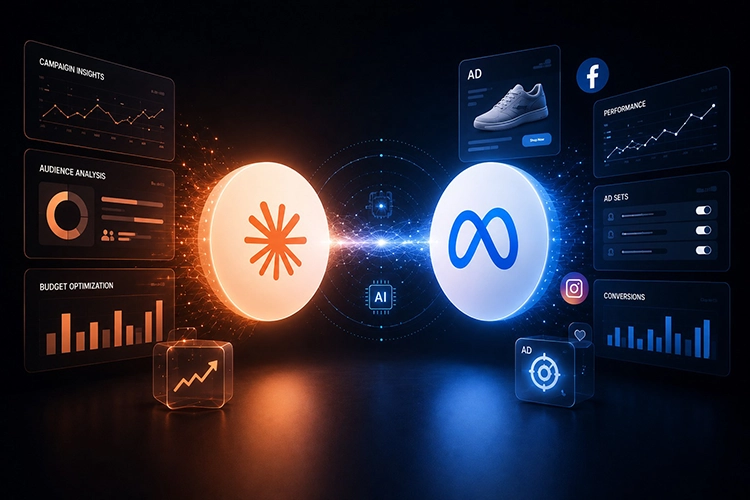
Meta just made one of its biggest AI moves yet.
And most businesses have not fully realized what it means.
AI assistants like Claude are beginning to connect directly with Meta advertising workflows, making it possible to analyze campaigns, monitor performance, and optimize ads conversationally instead of manually.
That may sound like a technical update. It is not.
The growing hype around Meta Claude ad integration signals a much bigger shift taking place inside digital advertising:
AI is moving from assistant to operator.
And for marketers, agencies, and businesses running paid campaigns, that changes the game faster than most expected.
So, What Actually Happened?
Meta has started allowing AI assistants like Claude to interact more directly with advertising workflows through MCP, or Model Context Protocol.
In simpler terms, Claude can now connect with parts of the Meta ad ecosystem and help marketers:
| ✅ Analyze campaigns | ✅ Generate reports | ✅ Monitor spend patterns |
| ✅ Identify performance drops | ✅ Review targeting | ✅ Assist with optimization workflows |
This is where the conversation around Claude connected to Meta Ads suddenly exploded.
Because until now, most AI tools worked outside the platform. You would manually export data, upload screenshots, or explain campaign performance yourself.
That process is changing quickly.
According to Meta (2026), these integrations are designed to make advertising workflows faster, more accessible, and more automated for businesses using Meta platforms.
Which sounds exciting. And honestly, it is.
But the bigger significance sits underneath the announcement itself.
| Curious how AI-driven advertising fits into your broader digital strategy? Explore paid advertising campaign at Digital Monk Marketing |
Alert! This Is Not a Regular Feature Update
You may think this is just another AI product launch. It is not.
This is infrastructure changing in real time.
The important shift is not that Claude can generate advertising insights. Plenty of tools already do that.
The real shift is that AI is beginning to operate inside marketing systems instead of outside them.
That changes how work gets done. Tasks that once took marketers hours inside Ads Manager can now happen conversationally:
“Which campaigns are underperforming?”
“Where is the budget being wasted?”
“What changed in the last seven days?”
That is a very different style of workflow.
And it is exactly why phrases like AI-powered ad management and AI ad campaign optimization are suddenly becoming part of mainstream marketing conversations.
At Digital Monk Marketing, we have already seen Calgary businesses asking versions of the same question:
“If AI can optimize campaigns instantly, what happens to agencies?”
It’s a fair question. But also slightly the wrong one.
What AI Can Do Surprisingly Well
As we already know, AI is extremely good at tasks like pattern recognition, repetitive optimization, performance analysis, and speed-based decision support.
A marketer might spend an hour reviewing campaign metrics across multiple ad sets. AI can process the same information in seconds.
That changes operational efficiency significantly.
For businesses running multiple campaigns, especially ecommerce or lead-generation campaigns, the appeal is obvious.
This is where the idea of Claude AI marketing integration becomes practical, not just theoretical.
And for smaller businesses in Calgary or across Canada, this could lower the barrier to sophisticated advertising analysis significantly.
The “heavy lifting” becomes lighter. But that still leaves the following important issue unresolved.
Strategy Still Does Not Come From a Dashboard
| “The real challenge is not whether machines think but whether men do.”— B. F. Skinner |
This is something that no viral posts are addressing: the strategy.
Yes, AI can optimize campaigns, but it still cannot fully understand people.
It does not deeply comprehend:
| ✅ Emotional positioning | ✅ Brand nuance | ✅ Local behavior shifts |
| ✅ Audience psychology | ✅ Cultural tone | ✅ Timing instincts |
Those things still matter a lot. A campaign can be technically optimized and still feel completely disconnected from the audience.
Anyone who has worked in advertising long enough has seen this happen.
The numbers look fine. The campaign still falls flat.
That is because performance marketing is not just mechanical. It is behavioral.
According to HubSpot (2025), automation improves efficiency most effectively when paired with strong strategic direction rather than replacing it entirely.
That distinction matters more now than ever.
| Something to note: AI can identify what people clicked on but It still struggles to understand why they cared. |
What This Means for Agencies
Honestly, agencies that only provide reporting and routine optimization should probably be paying attention.
Because operational work is becoming increasingly automated.
As automation handles more executional work, the value shifts elsewhere. Positioning, creative thinking, conversion psychology, audience understanding, and strategic direction are becoming the real differentiators.
That is the strange irony of this update. The more automation grows, the more human clarity stands out.
At Digital Monk Marketing, this shift actually reinforces something we already believed. The tools will continue evolving quickly. The strategy behind them still determines whether campaigns connect or disappear into the noise.
And let us be honest, there is already enough noise floating around Meta feeds these days to make your head spin.
| If your Meta campaigns feel reactive instead of intentional, it might be time to rethink the structure behind them. Take a closer look at our digital marketing services |
A Quick Look at the Shift
| Traditional Ad Workflow | AI-Assisted Workflow |
| Manual reporting across campaigns and ad sets | Conversational campaign analysis through AI |
| Human review of performance fluctuations | Real-time AI pattern detection |
| Slow optimization cycles | Faster budget and targeting recommendations |
| Data scattered across tools and dashboards | Centralized AI-assisted insights |
| Agencies spending hours on repetitive reporting | More time spent on creative and strategy |
That difference is going to reshape how marketing teams operate over the next few years.
Where This Is Heading Next
One thing is important to understand here is that this is not just about Meta.
Google is moving in similar directions. Shopify is integrating AI deeper into commerce workflows. CRM systems are becoming increasingly autonomous.
Marketing platforms are slowly becoming AI-native systems.
That is the real story here.
And honestly, most businesses have not fully processed what that means yet.
The Bigger Takeaway
The real significance of the Meta Claude ad integration is not that AI can now help manage campaigns.
It is that marketing platforms are starting to treat AI as part of the operating layer itself.
That changes workflows. Expectations. Speed. Decision-making. But it does not remove the need for human thinking.
If anything, it raises the value of it.
Because once everyone has access to automation, strategy becomes the actual differentiator.
To simplify the whole thing :
✅ Faster optimization does not automatically create better marketing
✅ The brands that win will be the ones combining AI efficiency with human understanding
| Wondering what this shift means for your business, we are always open for a conversation. Get in touch with our team |