
Remember when Google Search felt infinite? You could scroll through pages of results, dig up the weirdest corners of the internet, and maybe even find that random Reddit thread from 2013 that had exactly what you needed.
Those days might be fading, and not by accident.
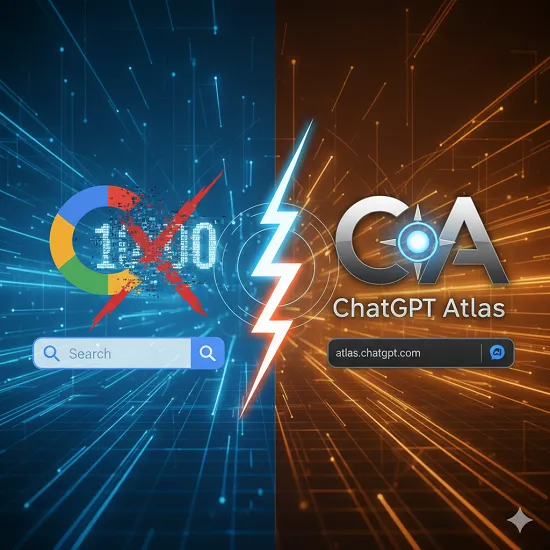
Over the last few weeks, Google quietly made a move that sent a ripple through the SEO and AI worlds: it removed the “num=100” parameter, a simple little trick that used to let people (and bots) see up to 100 results per search page.
Sounds small, right?
But that tiny switch completely flipped the game for data access, SEO tracking, and maybe ChatGPT itself.
And right when SEOs were picking their jaws off the floor, OpenAI launched its own “search-like” experience: ChatGPT Atlas.
Coincidence? Probably not.
So, it seems like the internet’s biggest gatekeeper tightens its grip, and the world’s most favorite AI decides to challenge it. Let’s unpack the story.
Contents
- Google’s “Num=100” Vanishes
- The Reason Behind Google’s Move: Control, Clarity, or Competition?
- ChatGPT Atlas: When AI Decides to Play in Google’s Sandbox
- The Timing? Oddly Perfect
- What This Means for SEO and Digital Marketing
- How Has the Industry Reacted So Far?
- A Peek into Google’s Mind
- The Bigger Picture: Search Is Becoming a Conversation
- Navigating the Shift: What Marketers Need to Know
- Wrapping Up: The Web Just Got Personal Again
Google’s “Num=100” Vanishes
For years, SEO companies and data tools have used a neat parameter &num=100, basically to tell Google, “Hey, just give me the top 100 results at once.”
It was an excellent way for:
- Rank trackers to gather data in bulk
- Researchers/Marketing tools analyzing search trends
- Marketers studying keyword performance beyond page 1
But in mid-September 2025, Google pulled the plug. The company’s official statement?
| “The use of this URL parameter is not something that we formally support.“ |
In simpler terms: we don’t want you scraping our data anymore.
The impact was wide and Immediate:
- SEO tools like Ahrefs and Semrush noticed huge drops in keyword visibility.
- Google Search Console data started to look unusual.
- Impression counts decreased for many sites. Not because rankings changed, but because Google simply stopped showing deep results in bulk.
- Many SEO-powered websites lost their rank.
Brodie Clark, a well-known SEO analyst, referred to it as “The Great Decoupling”; it marked the moment Google stopped sharing the ranking data that powered so many third-party SEO tools and studies.
So while the average internet user didn’t notice a thing, for marketers, analysts, and AI systems, the impact was immediate and immense.
The Reason Behind Google’s Move: Control, Clarity, or Competition?
While the search giant stays quiet about the “why,” a few theories are floating around; they all make sense in their own ways.
1. To protect its new search ecosystem.
Google’s pushing AI Overviews and Gemini integration hard. Restricting traditional result access will help draw both users (and data) toward their new interface, and away from anything that could train competing AI models.
2. To cut off scrapers and bots.
Google’s servers handle billions of queries a day. Allowing anyone to pull 100 results per page made it very easy for bots to hoover up data, which AI models (like ChatGPT or Perplexity) could use to learn from.
3. To clean up “human” data.
By cutting down bot traffic, Google ensures that key metrics, such as impressions and CTRs, more accurately represent real human activity rather than automated queries.
So yeah, it’s part data control, part performance tweak, and part defense strategy. Because let’s be honest: Google’s not just fighting SEOs anymore. It’s fighting AI itself.
ChatGPT Atlas: When AI Decides to Play in Google’s Sandbox
About a month later, OpenAI released something no one, not even marketing or AI experts, saw coming: ChatGPT Atlas, a full-fledged AI browser built to explore the web on its own.
Built on Chromium (the same engine as Chrome), Atlas isn’t just another browser. It’s like Chrome and ChatGPT had a baby; one that can read web pages, summarize them, and even help you act on what you find.
| Picture this: You Google something (or rather, “Atlas” it), and instead of a list of links, ChatGPT instantly tells you: “Here’s what these sites are saying, here’s what’s reliable, and here’s what you might want to do next.“ |
That’s not just search. That’s search with purpose.
According to Reuters, Atlas is currently available for macOS with other platforms coming soon.
| “A quiet but deliberate challenge to Google’s Chrome and Search dominance.” – The Verge |
And that’s exactly what it is. A bold move into Google’s home turf. Will it be a home run or a miss? We’ll find out soon enough.
The Timing? Oddly Perfect
We’ve tried to connect dots on our own.
| Timeline | What Happened | What’s the Significance? |
| Sept 2025 | Google disables num=100 | Makes large-scale data collection harder for AI & SEO tools |
| Oct 2025 | OpenAI launches ChatGPT Atlas | Introduces AI-driven browsing that can bypass traditional search |
| Same Quarter | Google pushes AI Overviews | Reinforces its own “AI search” while restricting traditional SERP access |
If you’ve noticed, there is a visible pattern.
Google tightens access. ChatGPT takes a step ahead and creates its own way.
Given how much ChatGPT relies on web knowledge, it makes perfect sense for OpenAI to stop relying on Google’s pipelines.
So Atlas isn’t just a browser. It’s a new door to the open web.
| In easier words: Google built the internet’s biggest library, but now it’s locking the shelves. ChatGPT responds, “Cool. I’ll make my own library, faster, fresher, and open to everyone.” |
What This Means for SEO and Digital Marketing
Enough of the tech talk. Let’s get to the part you’ve probably been waiting for: what does this actually mean for marketers?
We’ve done our homework at Digital Monk Marketing, and here’s what we can tell you:
1. Visibility is shrinking
If AI browsers like Atlas and Google’s AI Overviews keep summarizing everything, fewer people will “click through” to websites. So, you might still get impressions but expect less real traffic.
2. Content must evolve
Forget stuffing keywords. The next big thing is AI-readable content that’s structured, trustworthy, and detailed enough for chatbots to understand and summarize. Schema, sources, and FAQs? Total must-haves.
3. Brand presence matters more than ever
Considering AI answers are the new SERPs, your brand needs to be the one those answers quote. That means building strong authority, publishing consistently, and getting mentioned by trusted sources.
4. Expect less “visibility data” from Google
With the num=100 change, you’ll see fewer deep-ranking impressions and less “noise” in Search Console. But nothing to worry; a drop in impressions doesn’t always mean lower rankings.
5. Diversify your analytics
We can’t rely solely on Google Search Console or Analytics. Combine data from tools like Ahrefs, Semrush, and independent SERP crawlers (many of which are now adapting to the new reality).
How Has the Industry Reacted So Far?
- Ahrefs confirmed its rank-tracking depth dropped due to the change.
- SEO forums scratching heads with confusion as marketers saw “visibility losses” overnight.
- Search Engine Land reported that impressions fell by up to 60% for long-tail keywords, simply because those results aren’t being counted anymore.
- Logical Position called the move “a fundamental reshaping of SEO analytics.”
Meanwhile, OpenAI’s Atlas announcement was trending on X, with over 1.2 million mentions in 48 hours. Many see it as proof that users are seeking a more intelligent browsing experience. Is it though?
A Peek into Google’s Mind
So, is Google the bad guy here? Not really.
They’re just protecting their turf and getting ready for a smarter kind of search that’s more like a conversation. Every now and then, we see them rolling out updates and guidelines to help everyone keep up and stay relevant in this new AI world.
But what might be their long-term plan?
- Get users to rely on AI Overviews inside Search.
- Keep all the data and ad revenue within their walls.
- Limit how much third parties, including AI tools, can repurpose Google’s results.
It’s the classic “build the walls higher before the neighbors peek in” strategy.
But it’s 2025 and the internet isn’t just Google anymore. ChatGPT, Perplexity, and Anthropic are busy building bridges right over those walls.
The Bigger Picture: Search Is Becoming a Conversation
Evidently, we’re moving from “Search Engine Optimization“ to “Answer Engine Optimization.”
Because users don’t want to dig anymore. They want answers with clarity.
So, who will thrive in this new era of search?
- Brands with content that AI systems trust enough to quote
- Websites with pages designed to answer, not just to rank
- Businesses that structure their data clearly with schema, FAQs, and citations AI can easily read
- Teams that focus on depth and expertise, not just keywords So their content becomes a reliable source for summaries
- Companies with recognizable brand authority that machines associate with credibility
We believe this shift might actually be good news for marketers who play it smart.
- Fewer clickbait sites.
- Less noise.
- More meaningful, structured content that earns attention from both humans and machines.
Navigating the Shift: What Marketers Need to Know
If you’re a marketer, here’s your action checklist for this new search world:
- Track the right things. Focus on clicks, conversions, and engagement, not just impressions.
- Reoptimize for clarity. It’s time to make your content AI-friendly: structured data, clean copy, direct answers. No fluff.
- Experiment with AI browsers. Try ChatGPT Atlas or Perplexity to see how your brand shows up in those environments.
- Build authority. Backlinks and mentions still matter, but trust and expertise now count double.
- Stay curious. This is just the beginning of a bigger shift toward conversational discovery. Keep looking for new shifts and adapt accordingly.
Wrapping Up: The Web Just Got Personal Again
In the span of a few weeks, we’ve seen Google pull back the curtain and OpenAI pull it right back open.
It’s not just a tech battle, but a tug-of-war over who controls how we find truth online.
So yeah, Google may have closed one door… But ChatGPT didn’t knock. It built its own house. How strong? Remains to be seen.
And for marketers? No more obsessing over the algorithm and start mastering the conversation.
Because in this next era of search, visibility is not going to come from ranking higher. It’ll come from being the answer.
Want to know how your brand holds up in this AI-driven chaos? Let’s chat. Because at Digital Monk, strategy meets storytelling, and SEO still packs a punch, even when AI rewrites the rules.