
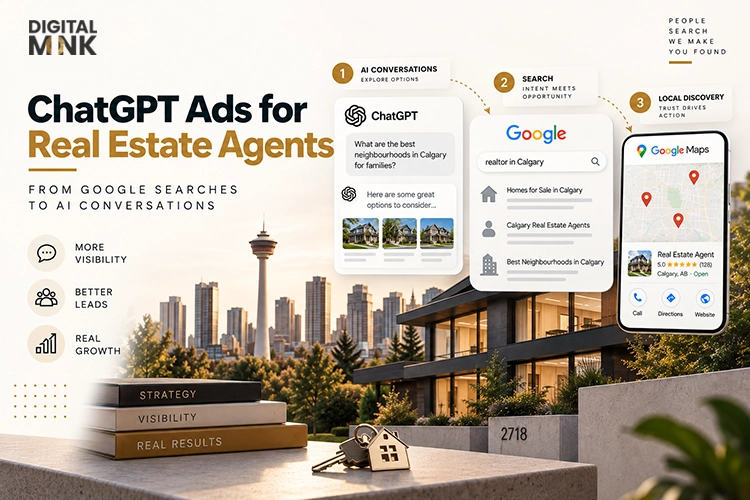
A property search can wander quite a bit before a realtor ever enters the picture.
Someone might ask ChatGPT whether Bridgeland suits a young family, compare Calgary neighbourhoods, check school catchments, or weigh a condo against a detached home. The agent search comes later, if it comes at all.
That changes the shape of ChatGPT Ads for real estate agents. Instead of waiting for a buyer to type “realtor near me,” advertising can enter the consideration phase, while Google Search and Maps remain important once intent sharpens.
The question isn’t whether realtors should advertise online. It’s whether they’re showing up where the conversation now begins.
Before the lead, there’s the journey.
We’ll follow it through three moments:
The conversation → AI and early-stage discovery
The search → Google, SEO and paid search
The decision → Maps, reviews and local trust
Because this isn’t really ChatGPT versus Google. It’s about what happens when a buyer moves between them.
ChatGPT Ads for Real Estate Agents: Where the Conversation Starts
Google usually meets a buyer when the search has already taken shape: realtor in Calgary, homes for sale in Kensington, condos near downtown.
AI can show up earlier.
A buyer might spend an afternoon asking about neighbourhood feel, commute times, schools, amenities or whether a certain price range makes sense before they ever look for an agent. The questions are messier, more exploratory, and often far removed from a traditional keyword.
That is where real estate AI advertising starts to differ. AI ads for realtors can use conversational context and intent rather than relying solely on a single search phrase.
Google often captures the search. AI can enter the conversation before the search happens.
And that raises a more interesting question: what exactly are these ads trying to reach?
What Are ChatGPT Ads for Real Estate Agents Actually Trying to Reach?
A Google search usually tells you what someone wants right now. A conversation can reveal what they’re still trying to work out.
A buyer may ask which Vancouver neighbourhood fits a young family, how long the commute might be, what amenities are nearby, whether renting still makes sense, or what to look for in a realtor. None of those questions says “find me an agent”, but they can sit remarkably close to that decision.
That is the territory ChatGPT advertising is beginning to explore. For AI marketing for real estate, the opportunity isn’t just to chase a keyword. It is to understand the context around the decision and potentially meet people while they’re still weighing their options.
For real estate lead generation, that earlier moment could matter.
| The Shift Search advertising asks, “What did they type?” Conversational advertising asks, “What are they trying to figure out?” |
And once that intent becomes explicit, Google Ads enters a very different part of the journey.
ChatGPT Ads for Real Estate Agents vs Google Ads: What’s Different?
The two channels can chase the same customer without doing the same job.
| Google Ads | ChatGPT Ads | |
| Starting point | Search query | Conversation/context |
| Intent | Often explicit | Often exploratory |
| Targeting | Keywords, audiences, location, etc. | Contextual signals and targeting |
| User mindset | Looking for something | Exploring or deciding |
| Typical opportunity | Capture existing demand | Reach people during consideration |
Google is built to capture a defined need. Someone searches “Calgary realtor”, and the intent is fairly plain.
ChatGPT Ads can work from the broader context of a conversation, using signals around what someone is exploring or trying to decide. OpenAI describes these ads as a different approach from keyword-based platforms.
That doesn’t make one channel a replacement for the other. PPC advertising Calgary businesses already use can capture demand that is ready to act, while ChatGPT advertising can potentially meet a prospective client earlier in the journey.
For real estate lead generation, the more useful question may be less which platform wins? and more which moment are we trying to reach?
Getting Found on Google Still Matters for Realtors
The AI conversation may start early, but Google still owns a hefty piece of the journey once a buyer starts looking for something concrete.
A neighbourhood page, market guide, property service page or well-built landing page can answer the questions that surface after that initial curiosity. For SEO for real estate agents, that means useful local content, clear expertise and pages built around actual buyer needs, not a pile of neighbourhood keywords.
And the numbers still point to the web as a major discovery channel.
| The Search Still Starts Online 51% of buyers found the home they ultimately purchased through the internet. 88% purchased through a real estate agent or broker. Source: National Association of REALTORS®, 2025 Profile of Home Buyers and Sellers, published November 2025. |
So, yes, a realtor can appear in ChatGPT Ads while barely registering in organic search. Those are two different visibility problems.
Turn High-Intent Searches Into Leads
The point isn’t to pick one and abandon the other. It is to make sure your visibility holds together when a buyer moves from “I’m figuring this out” to “I’m ready to look.”
Know More About Real Estate Marketing
ChatGPT Ads for Real Estate Agents Don’t Replace Google Maps
There’s still a very local moment in the buying journey: “Who can I call around here?”
A search for “real estate agent near me” or “best realtor in [neighbourhood]” can put Google Maps and the Google Business Profile for realtors right in front of a ready-to-act prospect. Reviews, service areas, accurate contact details and consistent website information all help turn that local search into a real option.
That makes local search for realtors a different game from conversational advertising. Google Maps for real estate agents is about local relevance and immediate action; ChatGPT Ads can reach someone earlier, while they’re still exploring.
For a closer look at how those local signals work together, read our guide to Google’s Local Pack and local customer calls.
Different moment. Different job. Same buyer.
Improve Your Local Search Visibility
The Real Estate Marketing Stack Is Becoming Three-Layered
The buyer doesn’t necessarily move through one channel anymore. The path can look more like this:
| ChatGPT: Conversational discovery + AI advertising 🠋 Google Search: Intent capture + organic content + paid search 🠋 Google Maps: Local discovery + reputation + immediate action |
A buyer might ask AI 🠊 search Google 🠊 check Maps 🠊 visit a website 🠊 read reviews 🠊 contact an agent. Each step adds another piece of confidence.
That makes digital marketing for realtors less about choosing a favourite platform and more about keeping those signals consistent. AI search optimization and ChatGPT SEO matter because ChatGPT can search the web and surface cited sources, while Google and Maps still handle more explicit and local intent.
Three channels. One buyer. The gaps between them are where visibility gets lost.
| The Search Journey Is Getting More Layered 1 billion+ weekly users. Tens of thousands of advertisers. $1B annualized ad revenue. ChatGPT is no longer just another place to ask a question. It is becoming another environment where people explore options, compare alternatives and move toward decisions. Source: OpenAI, August 31, 2026. |
Wrap Up: Your Next Client Could Start Anywhere
A realtor’s next lead might come through a Google search, a Maps listing, an organic article, a review, or a conversation with AI. The starting point is becoming harder to predict, which makes being visible across those moments increasingly useful.
ChatGPT Ads for real estate agents are one piece of that larger discovery system. They can sit alongside Google Search, SEO and Maps rather than operating in isolation.
The real advantage isn’t choosing between Google and ChatGPT. It’s making sure your business makes sense wherever the buyer starts asking questions.