
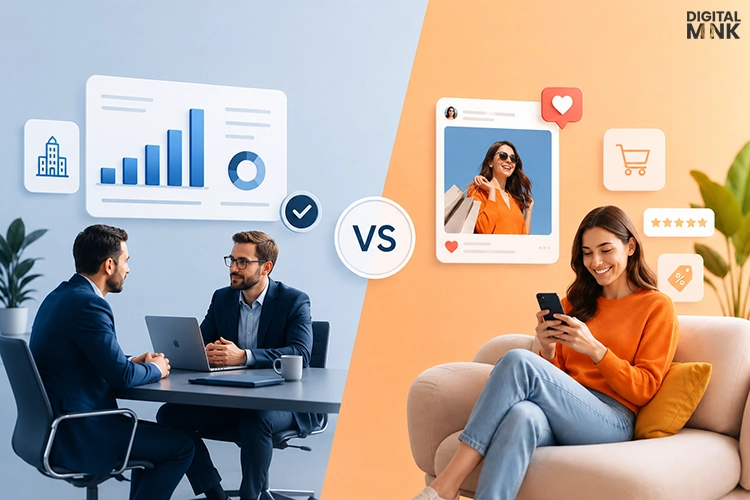
One of the easiest traps in marketing is assuming that what works for one business will work for another.
It’s understandable. We see a competitor posting regularly on LinkedIn, running ads, publishing blogs, and appearing everywhere online. The instinct is to think, “They’re growing. Let’s do what they’re doing.
The problem is that marketing tactics rarely exist in isolation. They work because they’re aligned with how a particular audience buys.
A strategy that generates leads for a software company may do very little for a local retail brand. Likewise, a consumer-focused campaign that creates thousands of impressions might not move the needle for a business trying to win a six-figure contract.
That’s why the B2B versus B2C conversation still holds significance in 2026, even though the line between them is getting thinner than ever.
The Real Difference Isn’t the Audience. It’s the Risk.
When people mention B2B digital marketing, the emphasis usually stays on the obvious differences. Longer sales cycles. Multiple decision-makers. Larger budgets.
Those things are true, but they aren’t really the heart of the issue.
The bigger factor is risk.
Imagine someone buying a pair of headphones online.
If they buy the wrong product due to any reason, it’s annoying. They return the product, leave a (negative) review, and move on.
On the other hand, think of a company opting for a new marketing agency, software platform, equipment supplier, or consulting partner.
Here, a poor decision can cost dearly; affect revenue, operations, customer experience, work environment, or even someone’s job. Naturally, the selection process becomes more cautious in this case.
No wonder B2B buyers spend a good amount of time researching, collecting information before finally contacting businesses. By the time they schedule a discovery call, they’ve often scrolled through numerous websites, read reviews, compared different providers, and discussed their options internally.
In many cases, the first conversation isn’t the beginning of the buying journey anymore. It’s somewhere in the middle.
This shift has changed what an effective B2B digital marketing strategy looks like. Visibility still matters, but visibility alone rarely wins the business. Trust, expertise, and credibility carry much more weight when the stakes are higher.
Why B2B Marketing Has Become More Human
For years, B2B marketing had a reputation for sounding overly polished.
Every company was “innovative.” Every solution was “industry-leading.” Every website looked remarkably similar.
Somewhere along the way, buyers stopped paying attention.
Today, decision-makers want expertise, but they also want authenticity. They want to understand who they’re working with, not just what they’re buying.
That’s one reason platforms like LinkedIn have become such an important part of the modern B2B landscape. Buyers aren’t just researching companies anymore. They’re researching people.
We’ve seen this firsthand across Calgary’s business community. Whether it’s engineering firms, healthcare providers, consultants, or professional service companies, prospects often look up the leadership team before they ever fill out a form.
They’re reading posts. Watching videos. Looking at recent activity. Trying to determine whether the people behind the business genuinely understand their challenges.
Simon Sinek captured this idea well:
“People don’t buy what you do; they buy why you do it.”
That quote gets repeated a lot, but there’s a reason for that. Buyers want confidence. They want alignment. They want to feel like they’re making the right decision, not just choosing the lowest price.
This is also why B2B lead generation has become more nuanced than it was a decade ago. Generating awareness is only part of the equation. Building familiarity often matters just as much.
| Looking to stay visible during longer buying cycles? Explore our Social Media Marketing Services |
B2C Buyers Have Changed Too
At first glance, B2C seems simpler. A person sees an ad, visits a website, and makes a purchase.
Sometimes that still happens.
More often, though, consumers are doing far more research than businesses realize.
A customer looking for a clinic, contractor, dealership, or local service provider today has access to an overwhelming amount of information. Reviews, videos, social media posts, Google searches, Reddit discussions, recommendations from friends. The list keeps growing.
People aren’t short on information anymore.
They’re short on confidence.
That’s why many successful B2C marketing strategies are less focused on persuasion and more focused on reassurance. Customers want to know they’re making a smart decision.
Interestingly, this is where B2B and B2C start to overlap.
Both groups are researching extensively.
Both groups are comparing alternatives.
Both groups are looking for signs they can trust.
The channels might differ, but the underlying behaviour is becoming surprisingly similar.
The Funnel Doesn’t Look Like It Used To
If you remember, a few years ago, marketing funnels felt fairly predictable.
Awareness at the top. Consideration in the middle. Decision at the bottom.
In 2026, reality is a bit messier.
Someone might discover your business through social media, read a review two weeks later, visit your website after that, and then return three months later through a Google search.
| Gartner found that B2B buyers spend surprisingly little time actually talking to suppliers, roughly 17% of the overall buying journey. The rest is often spent doing homework behind the scenes, comparing options, gathering opinions, and trying to avoid making the wrong decision. |
The path isn’t linear anymore.
This is particularly noticeable within the modern B2B marketing funnel. Buyers often jump between stages, revisit information, and conduct independent research before speaking to anyone.
So, what does this mean for marketers? It’s quite straightforward.
Businesses need to show up consistently across multiple touchpoints.
A strong website matters. So do reviews, content, and brand visibility.
Not because every customer will engage with all of those things, but because different customers build trust in different ways.
| Every touchpoint shapes perception. When your messaging, visuals, and customer experience all align, trust becomes easier to build. Explore our Brand Management Services |
What We Keep Seeing Across Both Markets
If there’s one thing we’ve learned over the last 15 years, it’s that businesses sometimes become too focused on channels and often overlook customers’ behaviour.
The conversation becomes:
Should we be on LinkedIn? Should we run Google Ads? Should we create more content?
Yes, those are valid questions, but they’re often asked before a more important one.
How does our customer actually make a decision?
Spend enough time around Calgary businesses and you’ll notice a pattern. The companies growing steadily aren’t always the loudest. They aren’t always publishing the most content or spending the most on advertising.
More often than not, they’re simply easier to trust.
Their message is clear.
Their reputation is solid.
Their online presence feels consistent.
Customers understand who they are, what they do, and why they should care.
That may not sound particularly exciting, but it’s remarkably effective.
| Peter Drucker said it best: “The aim of marketing is to know and understand the customer so well the product or service fits them and sells itself.” |
For all the changes we’ve seen in digital marketing, that principle has held up surprisingly well.
Digital Monk’s Perspective
For us, the B2B versus B2C digital marketing strategy debate isn’t really about platforms anymore.
It’s about people. How they research, compare options, build trust, and ultimately, make decisions.
The businesses witnessing an upward trajectory in 2026 aren’t necessarily the ones chasing every new tactic. They’re the ones that take the time to understand their customers and develop marketing strategies around that reality.
The tools will keep changing. The platforms will evolve. Buyer behaviour will continue to shift.
Understanding people, though, never seems to go out of style.
| Ready to build a marketing strategy around how your customers actually buy? Contact Digital Monk Marketing |