
A Google Ads account can look pretty healthy at first glance.
The cost per conversion is down. The conversion rate looks strong. Leads are coming in.
Then you open the search terms and notice something interesting: a sizable share of those conversions came from people who were already searching for your business by name.
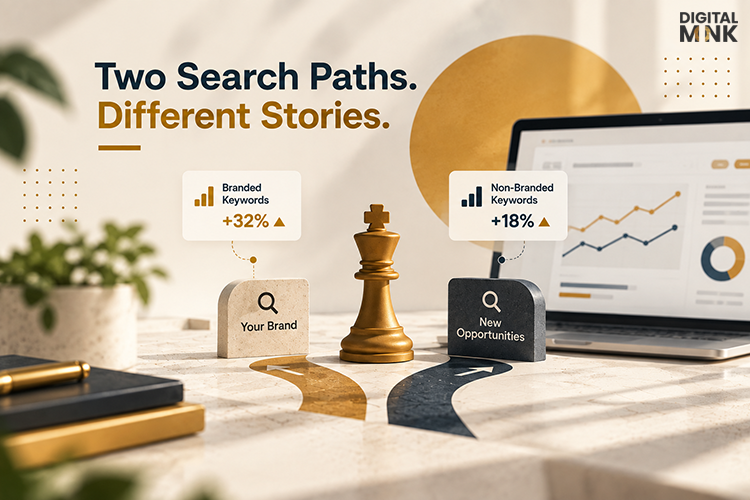
Branded vs non-branded keywords can produce very different numbers, even when both are generating conversions. A branded search often comes from someone who already knows the business. A non-branded search may come from someone still comparing options.
Put both into the same performance bucket, and the account can look more efficient than its non-branded acquisition really is.
So before comparing performance, separate the demand.
What Counts as a Branded Search and What Doesn’t?
A branded search contains something that identifies your business, product or brand. That could be the exact business name, a common misspelling, the brand plus a service, or the brand plus a location.
For example:
“Digital Monk Marketing” 🠊 branded
“Digital Marketing Agency Calgary” 🠊 non-branded
Google’s own Search Console reporting now separates branded and non-branded queries, with branded queries including brand names, domains, brand-specific products or services, plus common variations and misspellings.
In Google Ads, branded keywords Google Ads campaigns are generally capturing people who already have some awareness of the business. Non-branded search terms are different. They can come from someone searching for a service, problem or category without having a particular provider in mind.
That distinction matters because the two groups are entering your funnel from different starting points.
See what your Google Ads account is really telling you with a PPC Audit
Branded vs Non-Branded Keywords Can Make the Same Google Ads Account Look Completely Different
Two campaigns can generate the same number of leads and tell completely different stories.
Imagine one account where branded searches produce 40 leads at a $12 cost per conversion, while non-branded searches produce 25 leads at $32. Looking only at the account average could make the campaign look remarkably efficient. Looking at the two groups separately tells you where that efficiency is actually coming from.
That distinction can affect conversion rate, cost per conversion, CPA, ROAS and perceived campaign efficiency.
| Branded | Non-branded | |
| Knows your name? | Usually | Not necessarily |
| Search intent | Often navigational or decision-oriented | Often discovery or comparison |
| Main question | “Are you the business I want?” | “Who can solve this?” |
| What it tells you | Existing demand | Discovery demand |
Google Ads now provides brand inclusions and exclusions specifically to help advertisers manage branded traffic, reinforcing that brands and generic keywords can represent different types of search activity.
Source: About brand settings for Search and Performance Max – Google Ads Help
That doesn’t make non-branded keywords Google Ads traffic more valuable by default. It simply means the two groups deserve to be read in context.
And this is where looking only at conversions can get dangerous.
Your Google Ads Conversions Don’t Tell the Whole Story
A conversion is an event. It isn’t necessarily a good lead.
Ten inexpensive leads can look impressive on a dashboard, but three more expensive leads may be worth far more if they’re the ones that become real opportunities. That’s why Google Ads conversions should be examined beyond the number itself.
The same applies to Google Ads lead generation. Branded searches may produce quick form fills or calls because the person already knows the business. Non-branded searches can be more convincing because the prospect is still comparing providers.
So instead of stopping at cost per lead Google Ads reports, follow what happens next:
| Stage | What you’re really measuring |
| Lead | Did someone contact you? |
| Qualified lead | Was there genuine potential? |
| Opportunity | Did the conversation progress? |
| Customer | Did revenue actually follow? |
That is why lead quality also matters. A cheaper conversion isn’t automatically a cheaper customer.
Once you know which searches generated the leads, the next question is whether your account is giving you enough visibility into those searches.
A New Way to Run Google Ads Calgary Brands Love
The Search Terms Report Is Where the Real Story Starts
Campaign-level reporting can tell you that a campaign generated 50 conversions. It doesn’t tell you what people actually searched before converting.
The Google Ads search terms report shows you what sits behind those numbers. Separate brand variations from generic queries, then look at search intent, cost and lead quality.
A 10% conversion rate might look impressive until you discover most conversions came from branded searches. Meanwhile, non-branded searches may carry a higher cost per conversion while bringing in people who had never heard of the business.
The percentage isn’t the story. The searches behind it are.
So once you’ve separated the searches, what should you actually do with the two groups?
Branded vs Non-Branded Keywords Need Different Jobs
Branded vs non-branded keywords don’t necessarily deserve the same benchmark because they’re doing different jobs.
Branded 🠊 Capture + protect existing demand
Non-branded 🠊 Create + capture new demand
That can mean separate reporting, different budget decisions, messaging and landing-page expectations. It doesn’t mean every account needs separate campaigns. The right structure depends on the account and its objectives.
In paid search, branded activity can capture people already looking for you, while non-branded search advertising can reach people still comparing options. That distinction also matters for PPC lead generation, where lead volume alone doesn’t tell you which type of demand is actually growing.
The point isn’t to favour one. It’s to know what job each is doing.
And that distinction becomes even more interesting when paid search sits beside organic search.
What Your Paid Search Data Can Tell You About SEO
Non-branded Google Ads searches can reveal what people are actually looking for before they ever find your website organically.
If searches around “SEO company,” “local SEO,” or “digital marketing agency” keep producing qualified leads, that isn’t just paid search data. It can point to topics, landing pages and services worth building around organically.
A Calgary business might discover that searches converting through ads are already pointing toward local SEO Calgary.
Those patterns can influence which pages deserve more attention; from Calgary search engine optimization content to specific SEO services Calgary businesses are actively searching for.
Paid search can tell you what people are asking for. SEO can help you build an organic asset around that demand.
Explore Digital Monk’s Way of Calgary Local SEO
Don’t Let Branded Traffic Take Credit for Growth It Didn’t Create
“Google Ads generated 200 leads” isn’t enough for a useful report.
A better report separates the journey:
Branded leads 🠊 Non-branded leads 🠊 Qualified leads 🠊 Customers
That makes it easier to see whether advertising is capturing existing demand or creating new opportunities.
Branded demand still matters. But if someone was already looking for your business, that conversion shouldn’t automatically be treated as new demand created by advertising.
The same principle applies to organic search. If you’re comparing an SEO company Calgary businesses can work with or an SEO expert Calgary might recommend, the useful question isn’t simply how much traffic or how many conversions they report. It’s where that demand came from and what happened after the click.
Explore Calgary SEO Company Services
How to Read Your Google Ads Account Before You Change the Budget
Before moving another dollar into a campaign, ask five questions:
How much spend is branded? How much is non-branded? Which is producing qualified leads? What happens after the conversion? Are you measuring new demand separately from existing demand?
Those answers give you a better basis for budget decisions than the account-level conversion rate alone.
If the numbers still feel murky, a PPC management Calgary team can help separate the signals and look deeper into campaign structure and search behaviour.
Speak With Google Ads Consultant
| The Number That Can Fool Your Google Ads Report A low CPA doesn’t always mean efficient acquisition. If branded searches drive a large share of conversions, your account average can look stronger than your non-branded performance actually is. Brand demand ≠ new demand. Source: Google Ads Help, “Measuring branded searches.” |
Branded vs Non-Branded Keywords: The Lead Doesn’t Tell You Where the Demand Came From
A conversion is where the analysis starts, not where it ends.
Branded traffic tells you there was already some awareness of the business. Non-branded traffic tells you where people were still searching, comparing and discovering. Both matter, but combining them can blur the difference between capturing existing demand and creating new opportunities.
That’s why the useful question isn’t simply, “How many leads did Google Ads generate?” It’s “What kind of demand produced those leads?”
Whether you’re comparing PPC services Calgary businesses prefer or looking for google ads companies Calgary options, the same principle applies: look beyond the conversion count.
Separate the demand. Follow the journey. Then decide where the budget belongs.