
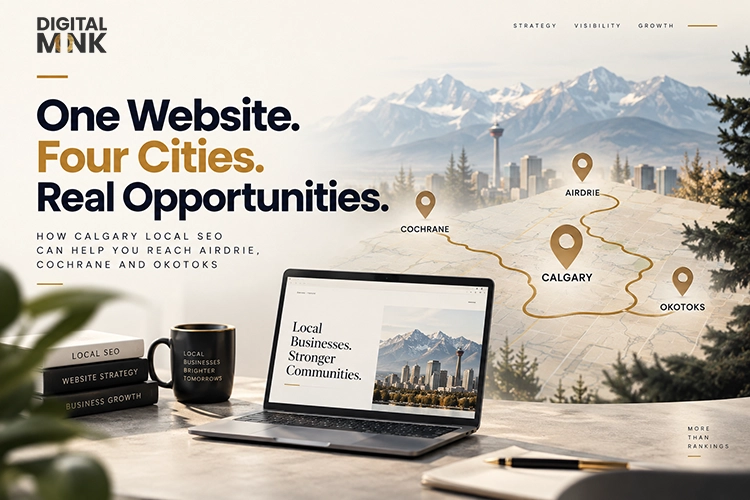
A Calgary business can have customers driving in from Airdrie, Cochrane and Okotoks, yet still find its visibility falling off a cliff the moment the search moves outside Calgary.
That usually leads to a very fair question:
“Why do we rank in Calgary but disappear in Airdrie?”
The answer isn’t simply more pages or more city names. Calgary local SEO sits somewhere between geography, relevance and how much genuine local evidence your website gives Google.
One website can reach several markets. The trick is making each market understand why you belong there.
One website. Four markets. Three things matter: proximity, relevance and local proof.
One Website Can Reach More Than One City. That Doesn’t Mean It Is Equally Local Everywhere
A single website can show up for searches across Calgary, Airdrie, Cochrane and Okotoks. There’s no rule saying a domain has to live inside one city’s borders to rank elsewhere.
But local visibility has a catch: the searcher’s location changes the landscape.
Someone searching for a service from downtown Calgary may see a different set of local results than someone making the same search from Airdrie. Google says local results are mainly shaped by relevance, distance and prominence, with distance referring to how far a business is from the person searching.
That makes Calgary local SEO less about planting your flag in every nearby city and more about building genuine relevance beyond your home base.
Your website can travel farther than your address. Your local signals still have to make the journey with it.
Get a Free Audit of Your Local Visibility
| Local Search Changes With Location Proximity matters to 44% of consumers when researching a local business, making it the most-cited factor in BrightLocal’s 2026 research. 52.8%–59.3% of local AI recommendations were within 5 km of the searcher, showing that geographic context can influence discovery even beyond traditional Google results. Sources: BrightLocal, “What makes consumers choose your business?”, July 15, 2026; BrightLocal, “What 200k local AI searches tell us…”, September 16, 2026. |
So if distance is only one piece of the equation, what can a website actually do to become relevant outside its home city?
The Four-City Problem: Calgary Isn’t Airdrie Isn’t Cochrane Isn’t Okotoks
Calgary, Airdrie, Cochrane and Okotoks may sit close together on a map. Search doesn’t treat them as one big neighbourhood.
Someone searching for a plumber in Airdrie isn’t necessarily looking for a Calgary company just because the drive is short. They want to know whether that company actually serves Airdrie, understands the area and can show up when needed.
That makes local search optimization more nuanced than adding four city names to the same page.
A useful location page should answer a few basic questions:
Do you serve this area?
What do you offer there?
Can you prove it?
Why should someone trust you?
A city name is a geographic signal. It isn’t local credibility.
This is also why local visibility goes beyond traditional organic rankings. Our earlier guide on Google’s Local Pack and local customer calls explores how proximity, relevance and prominence shape what people see in local search.
And once those differences are clear, the next question becomes much more practical: what should each location page actually contain?
What a Location Page Actually Needs to Earn Its Place
A location page needs more than a city name and a slightly rearranged service paragraph. It needs a genuine reason to exist.
If you serve Airdrie, explain why. That could mean the customers you work with, areas you cover, projects you’ve completed, or services that matter specifically to that market.
Then make the page useful in its own right. Include local context, distinct information and legitimate evidence such as relevant projects, testimonials, service details or local mentions. A Calgary copy with “Calgary” swapped for “Airdrie” won’t cut it.
The page should also make the next step obvious, whether that’s requesting a quote, booking an appointment or calling the business.
For businesses building location pages as part of a broader SEO service in Calgary strategy, the test is simple: would this page still be useful if Google didn’t exist?
That question exposes a lot of thin location pages.
Build Location Pages That Actually Work
But there’s one trap here: creating four pages doesn’t mean creating four local businesses.
Four Location Pages Don’t Give You Four Google Business Profiles
A website location page and a Google Business Profile do two different jobs. One can help your website build organic relevance for a market; the other represents an eligible real-world business location on Google Search and Maps.
That distinction matters. You can’t create a Calgary office, an Airdrie office, a Cochrane office and an Okotoks office on paper just to manufacture local visibility. Google requires business information, including addresses and service areas, to accurately reflect the real world.
For service-area businesses, Google allows one profile for the central business location with the areas genuinely served. Separate profiles are appropriate when there are genuinely separate, eligible locations.
| Local SEO Reality Check A location page can expand your organic reach. It does not create a physical location. |
Don’t manufacture addresses to manufacture rankings.
How Calgary Local SEO Can Expand Without Diluting the Website
The smarter approach isn’t dozens of city pages. It’s a location + service architecture that gives each market a clear role.
| Calgary | Airdrie | Cochrane | Okotoks |
| Core service pages | Relevant services + local context | Relevant services + local context | Relevant services + local context |
Only build a page when the business has something genuinely useful to say. That’s where local SEO Calgary strategies benefit from thinking like a Calgary SEO consultant, not a page factory.
Internal linking then connects the pieces:
Main service 🠊 Calgary page 🠊 Airdrie page 🠊 Related service.
The result feels less like a pile of city pages and more like one connected regional resource.
Build Better Pages for Local Search
| What Google Actually Uses for Local Ranking Relevance — how well the business matches what someone is searching for Distance — how far the business is from the searcher Prominence — how well-known the business is Source: Google Business Profile Help, “Tips to improve your local ranking on Google,” September 2026. |
Conclusion: Four Cities, One Website, Stronger Local Relevance
Yes, one website can reach customers across Calgary, Airdrie, Cochrane and Okotoks. But expanding your local footprint isn’t about multiplying pages or stuffing city names into every heading.
Calgary local SEO works better when each location has a genuine reason to exist, useful local context, relevant services and enough proof to support the claim.
Airdrie shouldn’t read like Calgary with the labels changed. And a location page shouldn’t pretend to be a Google Business Profile.
The better approach is simple: build where you have something real to say, connect those pages intelligently, and let relevance do the heavy lifting.
If you’re wondering where your website has room to expand locally, start with the evidence, not the city list.