

A business gets 40 leads from Google Ads.
The dashboard looks great. The sales team doesn’t.
After a closer look, only eight of those leads were actually worth following up with. The rest were poor fits, duplicate enquiries, or people who were never serious about buying.
So what does the ad platform learn from those 40 conversions?
That’s why conversion tracking is more than a reporting exercise. Google Ads conversion tracking, Meta Ads conversion tracking, and GA4 conversion tracking can tell you what happened, but the quality of the information matters just as much as the number itself.
If every form, call, or booking is treated as a win, the platforms may keep finding more people who behave the same way.
More conversions, perhaps. Better customers? Not necessarily.
Conversion Tracking Is Only Useful When You Track What Actually Matters
A form submission is an action. It isn’t automatically a good lead.
The same goes for a phone call, a booking, or even a purchase. What happened after that action is often far more useful.
Someone might fill out a form looking for a service you don’t offer. Another person might call with a genuine project and become a long-term client. Both could appear as “conversions” in a basic reporting setup.
That’s where Conversion Tracking needs a little more thought.
| Basic Tracking | Useful Tracking |
| Form submitted | Qualified enquiry |
| Phone call received | Relevant sales call |
| Booking completed | Genuine appointment |
| Purchase recorded | Valuable customer |
| All leads treated equally | Lead quality considered |
The goal isn’t to track every possible click and interaction just because you can.
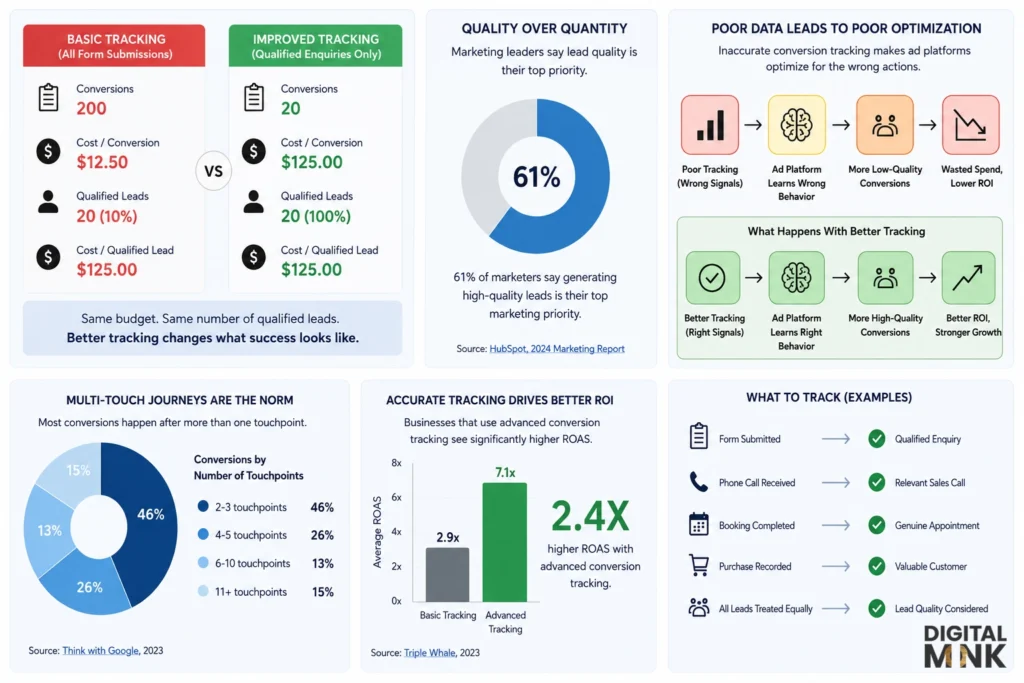
It’s to give your advertising platforms a clearer picture of what actually matters to the business.
Otherwise, you can end up optimizing campaigns for activity rather than outcomes.
And those two things aren’t always the same.
Google Ads Conversion Tracking Gets Smarter When Your Signals Get Better
Google can see a conversion. It doesn’t automatically know whether that conversion was valuable.
Imagine two campaigns. One brings in 100 form submissions. The other brings in 30 enquiries, but most of them are from people who actually need the service.
If your Google Ads conversion tracking treats both outcomes the same way, the platform has little reason to favour the second campaign.
That’s why the signals you feed into your campaigns matter.
A useful setup might distinguish between a form submission and a qualified lead, or between a phone call and a call that actually reached the sales team. GA4 conversion tracking can help you understand what people do across your website, while Google Ads can use relevant conversion signals for campaign optimization.
The point isn’t to make your reporting more complicated.
It’s to give the platform better information about what a good outcome looks like.
Because if you tell Google that everything is a conversion, don’t be surprised when it goes looking for more of everything.
Meta Ads Conversion Tracking Has the Same Problem
Meta has a different advertising ecosystem, but the basic principle is pretty similar.
If your Meta Ads conversion tracking tells the platform that every lead is equally valuable, it has no way to understand which ones actually helped the business.
A campaign might generate plenty of form submissions, purchases, bookings, and website interactions
But numbers alone don’t always reveal the entire story.
Was the purchase profitable?
Was the booking genuine?
Was the lead a good fit?
Did the person actually move closer to becoming a customer?
Those details give your data some context.
This is where website behaviour and lead-quality information become useful. The more meaningful the signals, the better equipped the platform is to learn from them.
Google and Meta don’t know which customer was worth your time simply because someone clicked an ad or filled out a form.
Your measurement setup has to give them enough information to learn what “good” actually looks like.
| A campaign can look fantastic on a report and still bring very little value to the business. That’s why we don’t think reporting should be about making numbers look impressive. If 50 leads came in but only five were genuinely useful, that difference matters. Integrity is quiet until it is felt, and sometimes it shows up in the details a report chooses not to hide. A good report should help you see what actually happened, not simply show you what looks good. Explore Our Lead Quality Reporting The goal isn’t better-looking numbers. It’s better-informed decisions. |
Better Attribution Helps You See What Happens After the Click
The ad click is rarely the whole story.
Someone might see your Meta ad on Monday, search for your business on Google a few days later, visit your website, leave, come back through organic search, and finally pick up the phone.
So who gets the credit?
If you’re only looking at the last interaction, organic search might get all the applause while the original ad gets overlooked.
That’s how attribution modeling proves its usefulness.
It helps you look at the different touchpoints that may have played a role before someone became a customer.
This matters when your analytics, paid media, landing pages, and lead-quality data are being looked at together rather than sitting in separate silos.
| A better campaign still needs somewhere useful to send people. Explore Our Website & Landing Page Design Services |
You don’t necessarily need a complicated attribution model to start asking better questions.
Sometimes it’s enough to stop asking, “Which channel got the conversion?” and start asking, “What happened before the conversion?”
That small shift can change how you judge your campaigns.
Smarter Ads Start Before You Increase the Budget
When a campaign isn’t delivering, the first instinct is often to spend more.
Before doing that, it’s worth checking what the numbers are actually telling you.
Are you tracking the actions that matter?
Can you tell a lead from a qualified lead?
Are calls and bookings being measured properly?
Are Google and Meta receiving useful signals?
Can you connect ad activity to actual business outcomes?
If the answer to some of these is “not really,” increasing the budget may simply give you more data with the same problem.
That is why effective digital marketing services Calgary businesses opt for shouldn’t treat paid media as a standalone exercise. Advertising works better when the campaigns, landing pages, analytics, conversion tracking, and reporting are looking at the same picture.
You don’t always need to spend more.
Sometimes you need to understand what you’re already spending a little better.
| Better tracking gives your ad budget better direction. Explore Our Paid Advertising Services |
Digital Monk Take: Your Ads Can Only Be As Smart As the Data Behind Them
Conversion Tracking isn’t just about knowing how many people clicked, called, submitted a form, or made a purchase. It’s about knowing which of those actions actually moved the business forward.
Better signals can help your campaigns optimize toward better outcomes. Better attribution can give you a clearer picture of what influenced a customer. And better reporting can show whether your advertising is producing something useful, not just something that looks good on a dashboard.
The goal isn’t to collect more numbers. It’s to understand the numbers you already have and use them to make better decisions about where your budget goes next.
The dashboard might show the conversion. Your business decides whether it was actually worth something